
Neurology Residency Rotations

PGY-1 Rotations
The PGY-1 neurology year will consist of thirteen 4-week blocks:
- 9.0 Internal medicine rotations, including general medicine, Med-ID, MICU, CCU, day float and night float
- 0.5 Neurology Subspecialty Clinics
- 0.5 Neurology Consult Service
- 0.5 Academic Neurology — This will occur towards the end of PGY-1 and will consist of Introductory didactics and orientation experiences so residents are comfortable with neurology service organization and workflow on Day 1 of PGY-2.
- 2.0 Electives (includes 1 week of vacation)
- 0.5 Vacation (plus paid week off June 24-30 at the end of the PGY-1 year)
Learn more about our Internal Medicine Residency, its leadership and its rotation structure.
Clinical Rotations
Outpatient Neurology
We recognize that many aspects of neurology practice occur only in the outpatient setting. We strive to make sure that the resident's outpatient experience is rich and varied so they will gain expertise in these areas. Outpatient experiences include:
- Resident continuity clinic: During PGY2-4 years of neurology residency training, the residents follow patients in their continuity clinic in the department's Neurology Care Center. Resident clinics occur in the same clinic where faculty see patients, with the same level of nursing and administrative support. Clinics are staffed by neurology clinical faculty, and residents are provided with increasing autonomy in patient management decisions as they progress through their training. There is no continuity clinic during inpatient service rotations. To allow residents focused exposure to outpatient neurology there are 1-week clinic rotations throughout the year in which residents will have five continuity clinic sessions, three faculty subspecialty clinic sessions and administrative time. Continuity clinics will also occur once per week during off-service rotations.
- University of Maryland Neurology subspecialty clinics: Residents rotate through the faculty subspecialty clinics to gain exposure to the unique patient populations that are referred to our specialists from across the region. The experience is tailored to each resident's interest and can include time with specialists in movement disorders, multiple sclerosis and neuroimmunology, epilepsy, stroke, neuromuscular disorders, headache, sleep, pain, neuro-oncology, neuro-ophthalmology and others.
- VA Medical Center clinics: All the neurology specialty divisions also operate outpatient clinics at the Baltimore VA Medical Center, allowing our residents to gain additional exposure to these diagnoses in multiple patient populations.
Inpatient Neurology
Residents participate in state-of-the-art neurology inpatient care.
- University of Maryland Medical Center: Residents rotate through the three main neurology services providing neurologic care to inpatients at UMMC:
- The Louis R. Caplan Stroke neurology service
- The William J. Weiner Clinical Neurology Service (CNS)
- The neurology inpatient consultation service
- The UMMC neurology services admit patients who arrive through the Emergency Department, consult on patients with neurological problems who have been admitted to other UMMC inpatient services and accept patients in transfer from multiple community hospitals who require a higher level of care or expertise offered by our specialists.
- Neurosciences Intensive Care Unit: The UMMC Neuro ICU has 22 beds staffed by two ICU teams. Each ICU team is led by a neurointensivist attending physician, and neurology residents receive invaluable experience caring for complex neurology patients under the guidance of experts in the field.
- VA Medical Center neurology consultation service: Patients with neurologic diagnoses who present to the VA Medical Center are admitted to the internal medicine services. PGY-3 neurology residents rotating at the VA gain valuable experience leading a consultation service and teaching medical students under the guidance of an attending neurologist.
Specialty Rotations
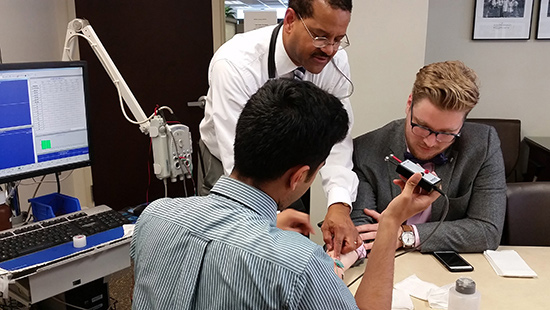
Residents rotate through multiple neurologic and related specialties during their training, including:
- Neuromuscular diseases/EMG: Patients referred to the neuromuscular specialty clinic are evaluated in the outpatient center and EMG/NCS studies are observed and performed.
- Epilepsy/EEG: Residents spend time with the epilepsy team in both the inpatient and outpatient settings. Alongside the epilepsy fellows and attendings, residents review continuous EEG recordings from the Epilepsy Monitoring Unit and throughout the hospital, as well as outpatient EEGs. Residents gain in-depth exposure to EEG analysis and management of patients with epilepsy and related disorders.
- Pediatric Neurology: Residents rotate for one month on the inpatient pediatric neurology consultation service at the University of Maryland Medical Center and for two months in the Johns Hopkins Pediatric Neurology subspecialty clinics. These experiences combine to provide a broad exposure to all types of pediatric neurology patients, including some diagnoses rarely encountered in many practices, under the guidance of experts in the field.
- Rehabilitation Neurology: UMMC neurology residents rotate through the neuroscience units at the University of Maryland Rehabilitation & Orthopaedics Institute, including units specializing in rehabilitation for patients with traumatic brain injury, spinal cord injury, and stroke. They work with the neurorehabilitation team (University of Maryland attending physicians specializing in neurologic rehabilitation, physical therapy, occupational therapy, speech therapy, social work) to provide the highest level of multidisciplinary rehabilitation care.
- Psychiatry: Neurology residents rotate through the University of Maryland Psychiatry consultation service to gain a better understanding of the diagnosis and management of psychiatric diagnoses and comorbidities.
- Elective Time: Neurology residents may use their elective time for additional exposure in any area of neurology or neuroscience, including further subspecialty clinical rotations, or pursuit of scholarly activities.
On-Call Coverage
The University of Maryland neurology program has a Night Float system for overnight coverage of the inpatient services. Residents do four weeks of Night Float during their PGY-2 and PGY-3 years, in two-week blocks.
The PGY-4 residents rotate being on-call from home to provide advice and assistance to the junior on-call resident in-house. There is also a system for a second-call resident, where a resident on a non-service rotation is available to come in and support the on-call resident should the volume of work prove too much for one person. Our residency fosters an atmosphere of camaraderie and teamwork, whereby each individual takes great pride in efficiently and appropriately treating the patients under their care, while also providing support to each other when needed.
Block Rotation Schedule
Schedule is based on thirteen four-week blocks per year.
Inpatient Neurology Rotations
| PGY-2 | PGY-3 | PGY-4 | |
|---|---|---|---|
| UMMC Stroke | 2 | 2 | |
| UMMC CNS (General Neurology Inpatient) | 2 | ||
| UMMC Neurology Consults | 2 | 2 | |
| Critical care | 1 | 1 | |
| Night Float | 1 | 1 | |
| VA Consults | 2 |
Outpatient and Specialty Rotations
| PGY-2 | PGY-3 | PGY-4 | |
|---|---|---|---|
| Neuromuscular/EMG | 1 | ||
| Epilepsy/EEG | 1 | 1 | |
| VA Neurophysiology (EMG+EEG) | 1 | ||
| UMMC Pediatrics | 1 | ||
| JHH Pediatrics clinic | 2 | ||
| Rehab | 0.5 | 0.5 | |
| Psychiatry | 1 | ||
| Continuity Clinics | 1 | 1 | |
| VA Subspecialty Clinics | 1 | 1 | 1 |
| Elective in Subspecialty clinics | 1.5 | 0.5 | |
| Elective | 1 | 3 | |
| Vacation (one two-week block and two one-week blocks) | 1 | 1 | 1 |
Advising and Mentorship
All residents are assigned a faculty advisor at the beginning of their residency. They meet with their advisor at least twice a year throughout the four years of residency to discuss: career goals, scholarly activity and any other questions or concerns. As residents get to know more attendings and identify areas of clinical and research interest, the advising/mentoring team will expand. All residents also individually meet with the Program Director twice a year to discuss their progress and any concerns. Residents find that the faculty are always happy to provide guidance to residents on scholarly projects, career paths or any other areas of interest.
Senior residents are another excellent source of guidance. Our neurology residents have varied interests and career plans. This creates a dynamic environment where residents learn from each other to build on everyone's prior experience and expertise.
Follow Us