UMM logo
 Print this page
 Email this page

 Connect with UMMC on:
 Twitter
 Facebook
 YouTube
 iPhone

 Share this page:

Bookmark and Share

Transplant Center

Patient Testimonials

Liver Recipients and Donors

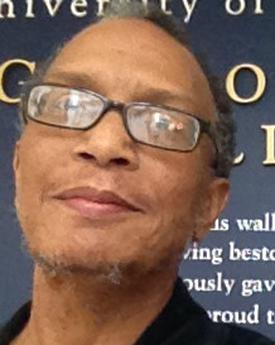
Rick Bounds

Liver Recipient

Rick Bounds

Rick Bounds

In July 2007, Rick Bounds underwent a kidney and liver transplant at the University of Maryland Medical Center. It's hard to believe that less than a year later, he would compete in a triathlon, complete with swimming, running and biking. But that's what the 53-year-old Essex man did in May, when he participated in the Pocomoke City Triathlon. Bounds used the triathlon as a fundraising opportunity for the University of Maryland Medical Center's Transplant Program. He says that since he has been given a second chance at life, he wanted to give back. Read full story


Sam (Kenny) Fike Sr. and Sam Fike Jr.

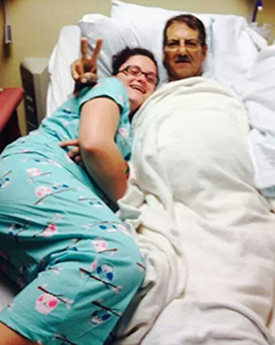
Sam Fike Sr., right with his son Sam Jr.

Sam Fike Sr., right with his son Sam Jr.

Liver Transplant Recipient and Donor

In 2005, Sam "Kenny" Fike Sr. was diagnosed with cirrhosis of the liver after an esophageal bleed. He then went to the University of Maryland Medical Center for treatment, where doctors told him he would need a liver transplant. Luckily, Kenny's son Sam volunteered to donate part of his liver to his father.

The living liver donor transplant took place at the University of Maryland in March of 2006. After the surgery, Fike Sr. says he felt "wonderful." Read full story


Donald Guyton and Russell Ward

Domino Liver Transplant Recipients

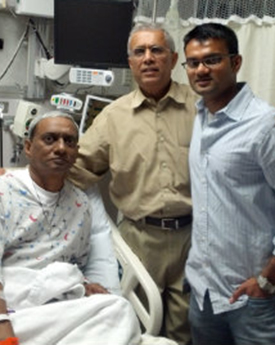
Russell Ward, left, (with his wife Dee) holds a medical identification bracelet given to him by Donald Guyton, right. Guyton's wife Louise is behind him.

Donald Guyton, 64, had a liver disease which was causing paralysis and eventually could have resulted in fatal heart damage. But for Russell Ward, 74, who was extremely ill with another type of liver disease, Guyton's liver proved to be a lifesaver. As part of a unique "domino" or sequential liver transplant, the first ever performed in Maryland, Guyton received a new liver from a deceased donor to cure his paralyzing disease. Then his liver was transplanted into Ward, who was suffering from liver failure.

The simultaneous transplants took place in an 18-hour operation on May 19, 2005. Read full story


David Rice

Liver Recipient

David Rice received a new liver from his son, David Rice, Jr., who was flown back to the United States from a Naval base in Japan for the 13-hour operation.

"I first started getting sick back in 1996. That is when I found out that I had cirrhosis of the liver. Blood wasn't flowing to my liver properly and instead I was bleeding into my stomach. I found myself throwing up blood.

I underwent a procedure to treat my condition, but they told me that I was eventually going to need a new liver. That is when I got on the national waiting list for a new organ.

Two years passed and it looked like I was going to be able to get through it without needing a new liver, but my stomach started bleeding again. My doctors told me that I would need to get a new liver right away or else I didn't have much hope. At that point, my liver was neither pumping nor cleaning my blood.

In addition to my cirrhosis, I had developed a hernia and gallstones. I had to have surgery for this first because my pancreas got infected and I had the aftereffects of a mid-range stroke, which affected my memory.

When you get a liver, they like for you to get it from a relative, if possible. If a relative isn't available, then they start looking at non-related living donors, and then at cadaveric donors. That is why my doctors thought my son, David Rice, Jr., who will be 22 this June [2003], might make a good donor.

David Rice, Jr.

David Rice, Jr., liver donor

My son's liver was a perfect match with mine - a six -- but I really didn't want to involve him at all. He flies aircrafts in the Navy and was stationed in Japan. When he found out I needed a liver, however, he said to me, 'I wouldn't be the man I am today if it weren't for you. This is the least I can do for you.'

It got to the point where I was so sick that my wife called the Red Cross. They arranged to have my son flown here from Japan within 24 hours.

The surgery took 13 hours, and they took 51 percent of my son's liver. It was a very successful operation. My doctors were using words to describe it like 'textbook'. They said everything went absolutely smoothly.

I remained in the hospital for about a week. I had to take 14 different medications to keep my body from rejecting my new liver. After two weeks, the swelling went down.

It takes about six weeks for the liver to grow back to its normal size. The operation took place on July 23rd [2002] and my son was able to go back to Japan around Labor Day, after he was cleared through the Bethesda Naval Hospital.

I really appreciated the care and attention that I got at the [University of Maryland] Medical Center. At some places you go, you feel like you are on an assembly line. But everyone at the Medical Center, from my surgeons to the transplant coordinator and all of the nurses, were patient with me and very attentive. They were all so knowledgeable of every detail of my case.

My coordinator would call me in the evenings, on the weekends and on holidays just to check up on me and see how I was doing. For the transplant team at the Medical Center, it isn't just a job. They really care about all of their patients personally."


Tim Thompson

Liver Donor

Tim Thompson, liver donor, and family

Tim Thompson, liver donor, and family

"When I found out that my boss would not survive for more than six months without a liver, I decided to get tested to become a donor. You have to be about the same size as the recipient and have the same blood type. I knew I might be a good match. Once that was established, I had to take a lot of tests.

There were blood tests, an MRI test (magnetic resonance imaging) and psychological tests. They wanted to make sure I had thought through my decision to become a donor.

They showed me pictures of the procedure and gave me lots of information on it. I knew that the procedure would involve them taking a portion of my liver - about half of it - to transplant into my boss. In about six to eight weeks, my liver would grow back to its original size.

For some reason, I was not nervous on the morning of my surgery. I was very calm. The transplant took about 10-1/2 hours. Despite some of the pain involved, I would still do it all over again. There is no greater gratification than saving a life."


If you would like to make an appointment or talk to someone about our services, please call 410-328-5408 or 1-800-492-5538.

This page was last updated on: January 30, 2009.